Buying a used car comes down to one question: will this engine drain your bank account?
Most buyers spend hours on the paint, the touchscreen and the smell of the seats. Then they open the hood, stare at a black plastic cover, check that the dipstick is wet, and hope for the best.
That is how people end up with a $2,500 repair bill three weeks after they buy.
You do not need an engineering degree to judge an engine. You need to know how engines fail, and which designs suit the driving you actually do.
Petrol or Diesel: Which One Should You Buy?
Most people choose between petrol and diesel by comparing prices at the pump. That single calculation ruins more car-buying decisions than anything else.
Petrol and diesel engines burn fuel differently. They handle heat differently. They break in different places. The fuel you pick decides how you have to drive the car, what routine servicing costs, and whether an expensive emissions repair is waiting for you.
| Feature | Petrol (Gasoline) | Diesel |
|---|---|---|
| Best for | Short trips, city commutes, school runs, low annual mileage (< 15,000 km / 10,000 mi). | Long highway journeys, heavy towing, long commutes (> 20,000 km / 12,000 mi). |
| Fuel economy | Moderate in city traffic, decent on open highways. | Exceptional on open roads, often 25–40% better range than petrol. |
| Warm-up time | Up to temperature in 5–7 minutes. Cabin heat comes fast. | Needs 15–20 minutes under load. Cold cabins in winter without an auxiliary heater. |
| Typical failure points | Spark plugs, ignition coils, PCV diaphragms, valve carbon, oil burning. | Clogged DPF, failed glow plugs, turbochargers, injectors, AdBlue faults. |
| Repair cost profile | Frequent, low-to-medium fixes ($100–$600). | Less frequent, but punishing when they come ($1,000–$3,500). |
How a Modern Diesel Cleans Itself (And Why You Shouldn't "Floor It")
A diesel is an endurance runner, not a city sprinter. To own one without pain, you need to know how it breathes and how it gets rid of waste.
Every modern diesel has a Diesel Particulate Filter (DPF) in the exhaust. Think of it as a dense ceramic honeycomb that traps soot.
That filter would clog, so the car burns it clean by itself. The process is called active regeneration. The engine's computer squirts extra fuel late in the cycle. That fuel oxidizes on the catalytic converter and pushes filter temperatures to roughly 600°C, over 1,100°F. The trapped soot burns down to microscopic ash.
Don't "drive it like you stole it"
There is a widespread myth that you should "drive it like you stole it", or hold the engine near the redline on the highway, to force a clean. Do not do this.
The computer only starts and finishes a regeneration inside a narrow window. It wants a steady cruise between 1,800 and 2,500 RPM, in 4th, 5th or 6th gear, for 20 to 30 minutes.
Pin the throttle instead and two things go wrong. The engine dumps a fresh load of raw soot down the pipe, and exhaust gas moves through the filter too fast. The computer reads those conditions as unstable, then delays or aborts the cycle.
Now picture a routine of 5- to 10-minute grocery runs and stop-and-go traffic. The exhaust never reaches those cruising conditions. The car starts a cycle, gets cut off part way, and dumps unburnt fuel past the piston rings into the oil pan.
Eventually the filter chokes on wet soot. Warning lights come on, the car drops into limp-home mode, and a replacement or a professional off-car bake costs $1,000 to $2,500.
The Modern Diesel Bonus Headache: AdBlue and NOx Sensors
Cars built to modern emissions standards, such as Euro 6, add another layer: Selective Catalytic Reduction (SCR). Most people know it as AdBlue, or diesel exhaust fluid.
The system injects liquid urea into the hot exhaust to neutralize nitrogen oxides. It runs clean when the car is new. As the miles pile up, urea crystals dry out and jam the injector tips. The heating element inside the AdBlue tank burns out. The NOx sensors degrade from the heat.
Once the control module logs a fatal fault, it gives you a countdown you cannot argue with: "Engine restart prevented in 800 km." Tanks, heaters and sensors routinely cost $800 to $2,000 to put right.
How Petrol Engines Behave in the Real World
Petrol engines run hotter inside, rev higher, and light the mixture with a spark. Petrol burns fast and leaves far less soot than diesel, so older petrol cars have no soot trap to clog.
From cold, a petrol engine, its coolant and its catalytic converter reach working temperature in a fraction of the time a diesel needs.
If your life is short trips, and the engine is often switched off before it has run 20 minutes, petrol suits that pattern with far less risk.
City abuse still causes faults on a petrol car. They are usually parts you can reach: an ignition coil, a fouled spark plug, an oxygen sensor reading erratically. That is a $100 to $300 headache, not a teardown.
Are Older Engines More Reliable Than New Ones?
Most people assume engines improve with every generation. For crash safety, cabin tech and lab emissions, they have. For mechanical simplicity and cheap DIY maintenance, modern engines are often more fragile.
Manufacturers did not design newer engines to last longer. They designed them to meet fleet emissions targets, and to make big power from small displacement.
Older Engines (Roughly Pre-2010): Simplicity and Breathing Room
Older petrol engines were mostly naturally aspirated, with port fuel injection. Port injection sprays fuel into the intake runners, behind the intake valves. Every intake stroke washes those valves in fresh petrol and its detergents. Cylinder pressures were low, the castings were thick, and the wiring was simple.
Older diesels were built like farm equipment. They had turbochargers for low-end torque, but no DPF, no second EGR cooler and no AdBlue. Exhaust gas left straight out of the tailpipe, with no backpressure choking the cylinder head. Give one clean oil and fresh fuel filters and it could run 500,000 kilometers without being opened up.
The trade-off: older engines drink more fuel, feel slow off the line, and are old. Coolant hoses harden, vacuum lines crack, and valve-cover gaskets weep oil. You will chase drips. The metal underneath is hard to ruin.
Newer Engines (Roughly 2012+): High Output, High Mechanical Tension
To meet carbon rules, makers downsized. The market is now full of 1.0, 1.2 and 1.4-liter three- and four-cylinder engines with small, fast-spooling turbochargers.
A 1.0-liter engine pushed to 140 or 155 horsepower is normal now.
An old 2.0-liter naturally aspirated engine made 140 horsepower with low cylinder pressure and relaxed heat. Getting the same power out of a 1.0-liter block takes extreme pressure, high heat and heavy loads. Those loads land on small pistons, small rod journals and thin bearings. The engine works near its limit every time you press the accelerator.
Almost all modern engines also use Gasoline Direct Injection, or GDI. It sprays fuel straight into the combustion chamber at over 2,000 PSI, which atomizes it far better.
Why Direct Injection Causes Carbon Build-Up
Fuel no longer passes the intake valves, so nothing washes them.
How it builds up: oil vapor from the PCV system, plus exhaust that pushes back into the port, lands on hot intake valves. The oil bakes onto dry metal. Over 80,000 to 120,000 km it forms thick, crusty carbon.
The "Italian tune-up" myth: many drivers believe a hard drive or a trip to the redline clears it. It does not. High load does clear soot off spark plug tips and out of the combustion chamber. It does nothing for the intake valves, because no fuel washes them and the extra heat only bakes the deposits harder. Once they choke, the car hesitates, misfires and runs rough. The only fix is to pull the intake manifold and blast the valves with crushed walnut shells, which costs $400 to $800.
Three Expensive Traps When Buying a Used Engine
Sellers count on buyers looking at shiny paint and a low odometer instead of the engine's design.
1. The "Low Mileage, City Car" Mirage
A 10-year-old car showing 50,000 km, or 30,000 miles, looks like a find.
It often is not. A low-mileage car used only for short city trips can be in worse mechanical shape than one with 180,000 highway kilometers.
City driving is severe-duty use:
- Cold starts and fuel dilution: a cold engine runs rich. On short trips that extra petrol washes down the cylinder walls, past the rings, and thins the oil in the sump. Thin oil lubricates badly, so wear speeds up on the crankshaft journals and camshaft lobes.
- Hours, not distance: 20 kilometers on the highway might take 12 minutes at a steady 2,000 RPM. The same 20 kilometers across town can take 90 minutes. That city car has run seven times more hours, with more heat cycles, more starts and more oil degradation than the odometer suggests.
- Grime: short trips never get hot enough to burn fuel and moisture out of the crankcase. The oil turns to sludge, and wet carbon cakes the intake runners and the exhaust.
2. The Oil-Burning Petrol Trap (Low-Tension Rings & Starvation)
Many modern petrol engines burn oil. To cut friction and gain a little efficiency, makers fitted thin, low-tension piston rings.
Dirty oil and fuel-diluted vapor bake carbon into the small oil return slots behind those rings. The rings then stick in their grooves and lose their spring tension. They can no longer scrape oil off the cylinder walls, and the engine starts drinking it. Some burn a liter every 1,000 kilometers.
The Catastrophic Consequence
Most drivers never pull the dipstick between services. A direct-injection engine that burns oil often ends up running on 1.5 liters of oil instead of its rated 4.0 liters.
At that level the remaining oil overheats, breaks down chemically and loses pressure. The top of the engine starves. Camshaft lobes score, the cam journals chew into the aluminum head, and the rod bearings take damage.
Walk away
If you pull the dipstick on a car you are inspecting and the oil does not register on the hash marks, that engine has run dry under load. Walk away.
3. The Stretched Timing Chain and "Wet Belt" Nightmare
Sellers like this line: "It has a timing chain, so you never have to replace a belt."
Modern chains are not the double-row roller chains of decades ago. They are thin, single-row chains, built to cut drag. Run one on 30,000 km oil intervals, about 20,000 miles, and the soot-filled oil works like liquid sandpaper on the chain pins. The chain stretches. The tensioner runs out of travel. The chain slaps its plastic guides. If it jumps a tooth on the cam sprocket, the valves meet the pistons and the engine is finished.
Worse is the wet timing belt, a rubber belt that runs inside the engine oil. Early Ford 1.0-liter EcoBoost and Stellantis 1.2-liter PureTech engines use one. Engineers put the belt in the oil bath to cut noise and friction.
The Failure Mode
Age matters, but the usual killer is the wrong oil. These belts need oils with additives that do not attack the rubber, such as Ford WSS-M2C948-B or PSA B71 2297.
Put in a generic 5W-30 or a standard C3 oil and the additives strip the rubber within 15,000 km. The belt swells, cracks and sheds its teeth into the sump.
Those rubber flakes get sucked into the oil pickup screen and starve the pump. The oil pressure light flashes, and the engine seizes within seconds.
How to Inspect a Used Engine Yourself: 6 Checks
You do not need a scanner or a toolbox to spot a failing engine. Bring a friend and work through these steps in order. Before you go, put the registration through the DVSA's free MOT history check: it lists the mileage recorded at every test, and the advisories the tester wrote.
1. Insist on a Cold Start
When you arrange the viewing, say it plainly: "Please do not start or warm up the car before I arrive. I need to see it from cold."
The moment you get there, open the hood and put your bare hand on the engine block or the exhaust manifold heat shield.
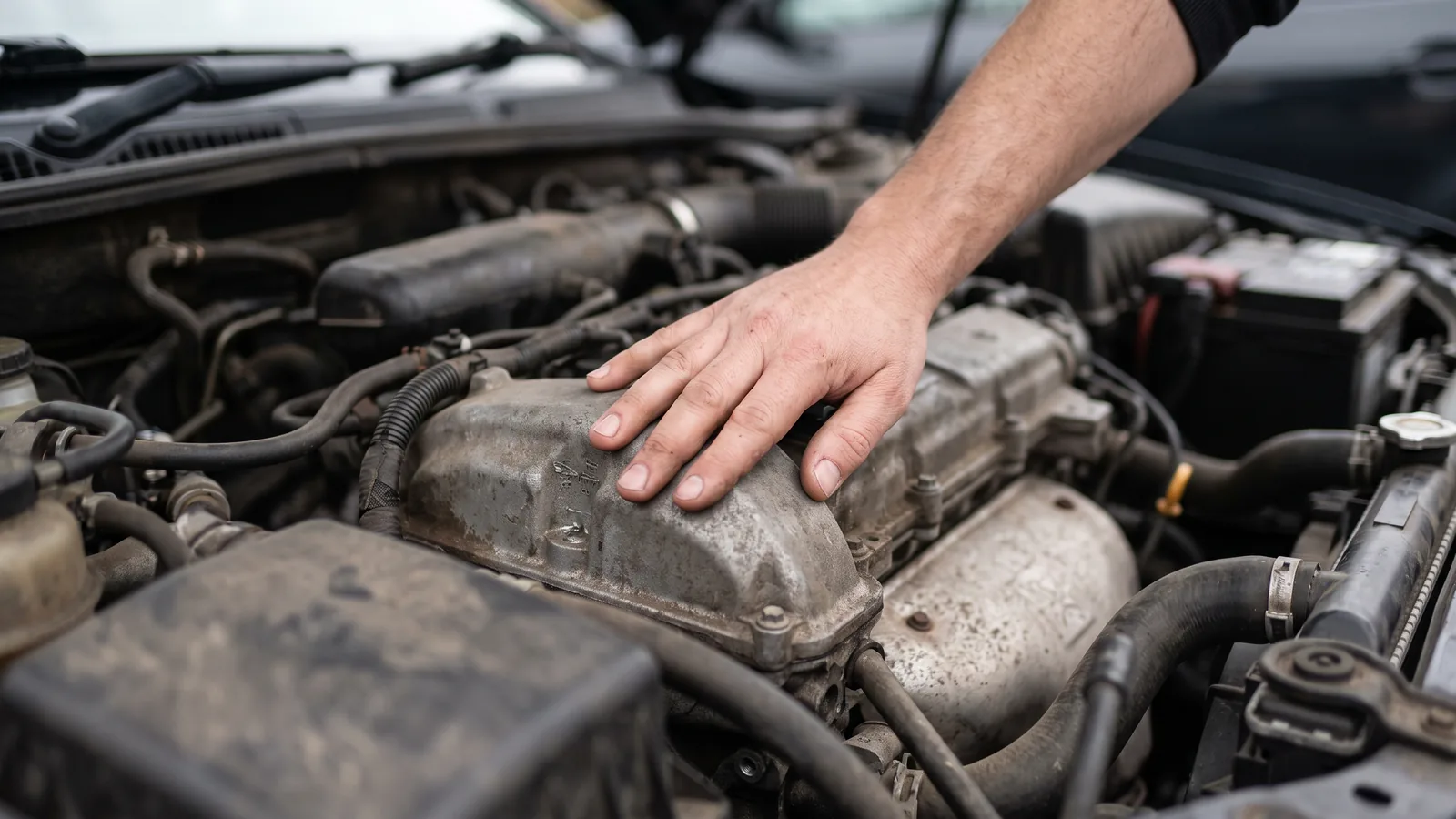
Cold metal means the seller did not warm the car up before you arrived.
- What you want: cold metal, the same temperature as the air outside.
- Why it matters: warming an engine up hides a lot. It quiets a loose timing chain that rattles from cold. It silences leaking hydraulic lifters. It burns off white condensation and blue startup smoke. It masks the thick additives poured in to hide a rod knock. It even lets a dying starter motor spin freely.
The Rule
If you arrive and the engine is warm to the touch, the seller ignored your instructions. Wait 45 minutes for the metal to cool, or walk away. There is a reason they wanted it warm before you got there.
2. What to Listen For in the First 10 Seconds
Stand beside the open hood, near the front wheel. Have your helper turn the key. Listen to the cranking, then to the first seconds of running.
Cranking Behavior
- Diesel, from cold: a common-rail diesel has work to do before it fires. It synchronizes the crankshaft and camshaft sensors, and pumps the rail above 250 bar, before the computer lets the injectors fire. Below 5°C, or 40°F, four to six revolutions before it catches is normal. Ten or more revolutions with coughing is not. Suspect weak glow plugs, low battery voltage, low compression or a tired high-pressure pump.
- Petrol, settling to idle: a cold petrol engine should fire and then idle above 1,000 to 1,200 RPM. That high idle is deliberate, because the computer is heating the catalytic converter. Over the next one to three minutes the revs should drop smoothly to a steady 700 to 800 RPM. If the needle bounces, hunts up and down, or sputters, suspect a vacuum leak or a badly calibrated throttle body.
Acoustic Red Flags to Catch
- Metallic rattle, 2 to 5 seconds: like pebbles in an aluminum can, right as the engine starts, gone once oil pressure builds. That is a stretched timing chain, or a collapsed hydraulic chain tensioner.
- Sharp ticking from the valve cover: a rhythmic metallic clatter from the very top of the engine that speeds up with revs. Those are worn or collapsed hydraulic lifters. They have lost their internal check valves and cannot hold valve clearance.
- Deep, rhythmic thud from low down: a heavy, dull knock from the bottom of the block is a worn connecting rod bearing. If it grows louder under throttle, the engine needs a full rebuild.
- High-pitched squeal: a glazed serpentine belt, or a worn alternator or tensioner pulley bearing. Budget $50 to $150.
- Puffing or chuffing: a rhythmic escape of air, often with the smell of raw diesel under the hood. That is a blown copper injector seat washer.
3. The Running Oil Cap Checks (Vacuum vs. Blow-By)
With the engine idling and warm, take the oil filler cap off carefully. It tells you how the crankcase is breathing.
On a Petrol Car (The PCV Check)
Unscrew the cap and lift it gently.
- Normal: a faint, gentle tug of suction holding the cap down.
- The defect: the cap is held down hard, and lifting it makes a loud, high-pitched tea-kettle whistle. The PCV pressure regulator diaphragm inside the valve cover has ruptured. It is a classic failure on engines like the BMW N52, N53, N55 and the VAG 1.8/2.0 TSI. The engine is pulling raw crankcase oil into the intake and drawing air through the crankshaft seals. Left alone, it blows out the main oil seals. The fix is a new valve cover or PCV assembly.
On a Diesel Car (The Blow-By Test)
Take the cap off, turn it upside down, and rest it loosely over the hole without threading it in.
- Normal: the cap vibrates and jiggles gently in place.
- The defect: crankcase pressure throws the cap clean off, or gray smoke chugs out of the hole like an old steam train. That is heavy blow-by. Combustion gas is getting past scored bores or worn rings and into the crankcase. The engine is worn out inside.
4. Check the Tailpipe and the DPF
With the engine running, have your helper rev it lightly to 2,500 RPM while you watch the exhaust.
The Clean-Finger DPF Test
On a modern diesel with a DPF, wait until the tip is cool and wipe the inside rim with your index finger.
- Healthy DPF: your finger comes out clean, or with a faint film of dry grey dust.
- Broken or gutted DPF: thick, greasy, velvety black soot. The ceramic filter inside is cracked, or it has been illegally hollowed out. The car will fail modern tailpipe particulate emissions inspections.
What Blue, White and Black Exhaust Smoke Mean
- Blue or gray smoke: the engine is burning oil. Worn piston rings, valve stem seals, or a failed turbocharger oil seal.
- Thick white smoke, with a sweet smell: coolant is getting into the cylinders, through a blown head gasket or a cracked cylinder head.
- Heavy black smoke: the engine is over-fueling. Stuck injectors, a split intercooler hose, or a faulty mass airflow sensor.
5. Suspension Health Revealed by Tire Wear
Before you drive, turn the front wheels to full lock and look at the tread across all four tires. Uneven wear exposes suspension faults that an alignment cannot always fix.
- Worn on both outer edges: the car was driven on under-inflated tires.
- Worn down the center strip: the tires were over-inflated, so the middle took all the load.
- Worn on one edge only: that points to mechanical trouble. Inner-edge wear is a classic sign of too much negative camber or toe-out, caused by sagging springs, collapsed control arm bushings or bent tie rods. If parts are bent or seized from curb strikes, no alignment will fix it without a front-end rebuild costing hundreds.
6. The Road Test: Drivetrain Dynamics
Turn the stereo off, put the windows down, and listen as the car pulls and as it slows.
- Dual-mass flywheel: a failing DMF does not slip like a clutch. It talks. Listen for a dull, metallic rattle at idle in neutral. Press the clutch fully: if the rattle changes pitch or stops, the springs inside are worn. Then switch the engine off without pressing the clutch. If the car shudders with a metallic "clack-clack" as the crank stops, the flywheel is at the end of its life.
- Load hesitation: in 3rd or 4th gear at 1,800 RPM, go to full throttle. The car should pull smoothly. A shudder, a stumble or a surge means weak ignition coils, failing injectors, or an intake choked with carbon.
- Turbocharger noise: a healthy turbo makes a quiet whoosh under boost. A loud whine, like a distant siren or a dentist's drill, means the turbine shaft is out of balance and touching its housing.
Which Used Engines Are Safe Bets, and Which to Avoid
Reliability is not about the badge on the hood. It is about specific designs and engine codes.
The Low-Stress, High-Mileage Safe Bets
If you want predictable running costs and few trips to the shop, look for these engine families. Every engine we have scored is ranked in our most reliable diesel, most reliable petrol and cheapest to maintain lists.
Naturally Aspirated Japanese Petrol Engines
- Toyota 1.5L, 1.8L and 2.5L (1NZ, 1ZZ/2ZR, 2AR families): simple port injection, low internal stress, and tough timing chains.
- Honda 2.0L and 2.4L K-Series (K20/K24): durable timing chains, strong bottom ends, reliable valve gear.
- Mazda SkyActiv-G (2.0L and 2.5L): these are direct-injection engines running an unusually high compression ratio, but Mazda left the base models without a turbo. A multi-hole injection strategy and a 4-2-1 exhaust manifold scavenge heat well, so these largely avoid the severe intake-valve fouling that plagues other direct-injection engines.
Proven Highway Diesels
Volkswagen and Audi 1.9 TDI and 2.0 TDI: the older 1.9 TDI, with its unit injectors, will outlast the car around it. For something newer, the common-rail 2.0 TDI built from late 2008 on is very robust once the timing belt has been done.
Buyer Note
In markets with lower-lubricity diesel, such as North America, the Bosch CP4 high-pressure pump can fail badly. Its roller cam can rotate, then grind metal shavings through the whole fuel system, a repair north of $4,000. On a CP4 engine, quality fuel, a lubricity additive and fresh fuel filters are not optional.
BMW M47 and M57, four and six cylinder: cast-iron blocks that pass 400,000 km without drama.
Swirl Flap Warning
The mid-2000s updates, the M47TU and M57TU, have metal swirl flaps in the intake manifold. Their mounting screws work loose, the flaps drop into the combustion chamber, and the pistons are destroyed. Blank them off with delete plugs, or fit an upgraded manifold.
The manifold issue: the original M57 used a cast-iron exhaust manifold that is close to indestructible. The mid-generation M57TU, in the early E60 530d for example, got a stamped stainless sheet-metal manifold instead. It cracks along its welded seams and pushes fumes into the cabin blower. Owners usually retrofit the older cast-iron manifold, or a cast aftermarket one. The later M57TU2, the M57N2 in the 335d and the late E60 LCI, went back to cast iron, which largely ended the problem.
Mercedes-Benz 2.2 CDI (OM611 and OM646): found in the older C-Class, E-Class and Sprinter vans. A tough bottom end built for commercial mileage.
PSA and Peugeot-Citroën 2.0 HDi, also sold as the Ford 2.0 TDCi: durable cylinder heads, dependable Siemens and Bosch injection, strong bottom ends.
High-Risk Engines Beginners Should Avoid
Without a complete, traceable service history and a warranty, beginners should stay away from these:
- Early wet-belt engines: the Ford 1.0 EcoBoost and the Stellantis 1.2 PureTech, built before the timing updates. Without proof of factory-spec oil changes, a blocked oil pickup is a real risk.
- Early direct-injection turbo guinea pigs: the VW and Audi 1.4 TSI "Twincharger", with both a turbo and a supercharger, is known for cracked piston ringlands. Early 1.8 and 2.0 TSI engines (EA888 Gen 2) suffered premature chain tensioner failures and heavy oil consumption from defective rings.
- Cheap used V8s and V10s: an aging BMW twin-turbo V8, such as the early pre-TU N63, or an Audi 4.2 V8 with its timing chains at the back, might cost $6,000 to buy. The parts and the labor still cost what they did on a $90,000 car. On early N63 engines the turbos sit inside the hot vee. That heat bakes the valve stem seals until they go brittle, so the engine burns oil, while plastic coolant lines degrade and piezo injectors clog. Replacing those seals or the timing gear often means pulling the engine out of the car.
What to Service Straight After Buying a Used Car
The seller will almost always tell you the same thing: "It was just serviced last month, it needs nothing."
Assume that is not true.
Sellers routinely top cars up with cheap, off-spec oil, fit budget filters, or simply clear the service light with a $15 scanner.
The best money you can spend is the zero-mile rule: budget $500 to $800 right after you buy, and reset the maintenance clock yourself.
The Day-One Fluid & Component Baseline
- Engine oil and an OEM filter: drain whatever is in the sump. Refill with the exact viscosity and manufacturer approval named in the handbook, such as VW 504.00/507.00, BMW Longlife-04 or Ford WSS-M2C948-B. Hydraulic chain tensioners, turbo bearings and variable valve timing solenoids all depend on it.
- Coolant drain and flush: antifreeze contains corrosion inhibitors that break down over time and turn the liquid acidic. Old coolant quietly eats radiator cores, heater cores and aluminum water pump impellers from the inside out.
- Brake fluid flush: brake fluid absorbs water from the air, mostly through the reservoir cap vent as the pads wear and when the cap comes off. That water lowers the boiling point, so the brakes fade under hard use, and it corrodes the valves inside the ABS pump. Bleed until clean fluid comes out of the screws.
- Transmission and differential oil: no oil lasts forever, whatever "sealed for life" suggests. Fresh manual gear oil, or new automatic fluid and filter, clears out clutch material and metal shavings, and extends valve-body life.
- Spark plugs on a petrol car, fuel filter on a diesel: worn plugs make the ignition coils work harder, and the misfires that follow melt catalytic converters. On a diesel, a clean fuel filter is the main defense protecting a high-pressure pump like the CP4 from water and abrasive metal.
- Engine and cabin air filters: a blocked engine filter starves the turbocharger and costs fuel. A blocked cabin filter strains the climate blower motor.
Once that baseline is done, log the date and the mileage. From here the maintenance history is yours: clean fluids, known intervals, and an engine set up to give you predictable miles.